
Today Governor Josh Stein joined Senator Natalie Murdock, the Legislative Black Caucus, and the North Carolina Department of Health and Human Services to recognize Black Maternal Health Week and raise awareness of ongoing disparities in maternal and infant health outcomes.
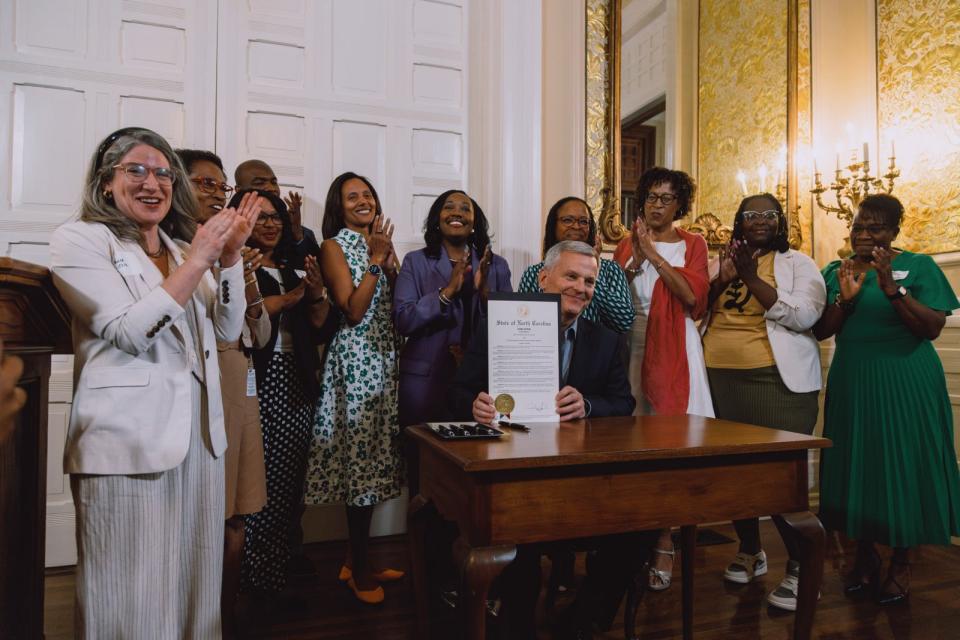
“Black women are nearly twice as likely as white women to die from pregnancy complications in North Carolina,” said Governor Josh Stein. “We cannot accept these disparities as a fact of life, so we must take action to ensure that all mothers and their babies receive the health care they need.”
“I have seen too many friends who have almost died from childbirth, and it can be exhausting having to explain to the public that women who look like me are prone to lower-quality care and too often lack the preventive care we need to stave off disease,” said Senator Natalie Murdock. “But we have a duty to rise to the occasion, stand up, tune out the noise, stay focused, and keep pushing forward to increase positive outcomes for Black mothers and infants.”
“It is our mission to improve the health and well-being of every individual in North Carolina, but we acknowledge a difficult truth: Negative maternal health outcomes for Black women are unacceptably high,” said Debra Farrington, NCDHHS Deputy Secretary for Health. “NCDHHS is committed to addressing disparities in maternal health and will continue its work with partners to ensure mothers get the care they need when they need it before, during, and after pregnancy.”
Governor Stein is committed to expanding access to care for mothers and their families. Last month, Governor Stein called on the General Assembly to pass a $1.4 billion Critical Needs Budget that addresses North Carolina’s most urgent needs while lawmakers continue to work on a comprehensive state budget. The budget includes $319 million to fully fund Medicaid, which covers half of all births across North Carolina and supports OB/GYNs, midwives, pediatricians, and behavioral health professionals who provide essential care for mothers and infants.
Governor Stein and his administration are also investing in strengthening health care access in rural communities. North Carolina has the second-largest rural population in the country, with more than 3.5 million people living in rural areas. In December, Governor Stein and the North Carolina Department of Health and Human Services (NCDHHS) secured $213 million from the federal Centers for Medicare & Medicaid Services through the Rural Health Transformation Program to improve health care access, including maternal and perinatal services.
For Black women, 57% of pregnancy-related deaths occur during pregnancy or within the first six weeks of the postpartum period. Nearly 80% of pregnancy-related deaths were preventable. Early warning systems in North Carolina save lives. Through the Maternal Health Innovation Program, the “I Gave Birth” initiative has been implemented at approximately 50 birthing facilities in North Carolina with more sites to come through the NCRHTP. “I Gave Birth” provides postpartum women with education and “I Gave Birth” bracelets to wear for six to eight weeks after delivery. It also trains obstetric providers, nurses, emergency department teams, and Emergency Medical System personnel to recognize and respond quickly to post-birth warning signs. Also critical to postpartum care after delivery, Governor Stein signed into law House Bill 546 last year, permanently expanding postpartum Medicaid coverage from 60 days to one year.
The North Carolina Making Access to Treatment, Evaluation, Resources and Screening Better (NC MATTERS) program works to reduce barriers to screening and treatment by supporting the providers who care for pregnant and postpartum patients. In partnership with the NC Psychiatric Access Line, NC MATTERS has supported providers serving more than 1,600 patients.
Additionally, the free and confidential national Maternal Mental Health Hotline is available 24/7 through the federal Health Resources and Services Administration Maternal and Child Health Bureau. Anyone seeking help can call or text 1-833-TLC-MAMA to connect with trained professionals for support, information, and referrals to local providers.