
Today Governor Josh Stein held his latest NC Strong Update to highlight ongoing initiatives to lower the cost of living for North Carolina families and keep people safe.
Lowering Energy Bills
As temperatures drop and North Carolina families turn their heat on, Governor Stein continues to address the need to combat rising utility bills. The Governor’s bipartisan Energy Policy Task Force found that electricity rates could increase by as much as 70% over the next 15 years, and key factors in this increase are the large energy loads of data centers, which make up approximately 30% of new energy projects but 80% of projected future energy demand. According to a new report done in conjunction with the Energy Policy Task Force, data centers’ large energy loads will create $50 billion more in costs through 2050.
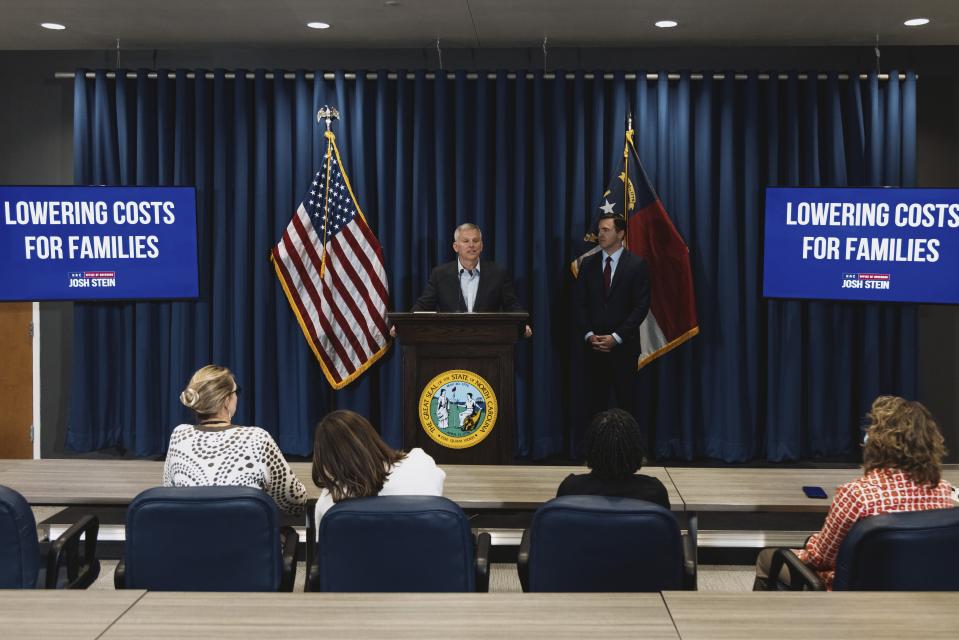
“Data centers’ large energy loads are going to create $50 billion in costs for all ratepayers, and if nothing changes, families will have to foot data centers’ bill. That’s unacceptable. We need to bring real rate relief for North Carolinians,” said Governor Josh Stein. “The Utilities Commission has the chance to protect people’s utility bills by voting to approve large load tariffs, and I am calling on the commission to get it done.”
“Families shouldn’t pay for the cost of new data centers. That’s what we’ve been fighting for in these cases," said Attorney General Jeff Jackson. "Duke’s proposal is a real step in that direction, and it puts more of the cost on the data centers, where it belongs. It’s not final yet, and we’re going to keep pushing for more.”
For months, Governor Stein has called for large load tariffs to protect North Carolinians from the costs of data centers’ massive energy use and urged the Utilities Commission to require data centers to pay the full cost of their impact and bring their own clean energy. Governor Stein and Attorney General Jeff Jackson recently responded to Duke Energy’s proposal to create North Carolina’s first-ever large load tariff and establish rules that apply to data centers and other large energy users. Duke Energy’s settlement has important new ratepayer protections, such as requiring data centers to cover their energy grid costs. However, it falls short in other areas, such as on how to deal with generation. To fill these gaps, Governor Stein is calling for the Utilities Commission and the relevant parties to continue their work and make sure data centers pay the full cost of their impact, including generation, and bring their own clean energy.
Over the past year, Energy Futures worked in collaboration with the Energy Policy Task Force on energy costs and the impacts of various policies in North Carolina. Energy Futures Group’s report made the following findings:
- Large loads will cost $50 billion over the next 25 years. In the business-as-usual scenario, large loads, a majority of which are data centers, account for 85% of new demand through 2035. The rate of load growth projected in the next 15 years is five times the rate that was seen in the past 20.
- Pursuing a net zero target reduces costs for ratepayers. If North Carolina plans for the future now, starts cutting emissions in the mid-2030s rather than later, and puts in place supportive policies like grid-enhancing technologies, it would save the ratepayers $14.6 billion compared to business as usual.
- Letting large load customers bring their own generation saves ratepayers. A program where just half of new large customers directly pay for or bring the clean energy they have committed to and operate flexibly would save other ratepayers $20 billion.
Click here to read the report.
Supporting Survivors of Domestic Violence
October is Domestic Violence Awareness Month, a time to draw attention to this heinous crime and the state's work to confront it. According to the North Carolina Coalition Against Domestic Violence, at least 66 homicides in North Carolina were direct results of domestic violence in 2025.
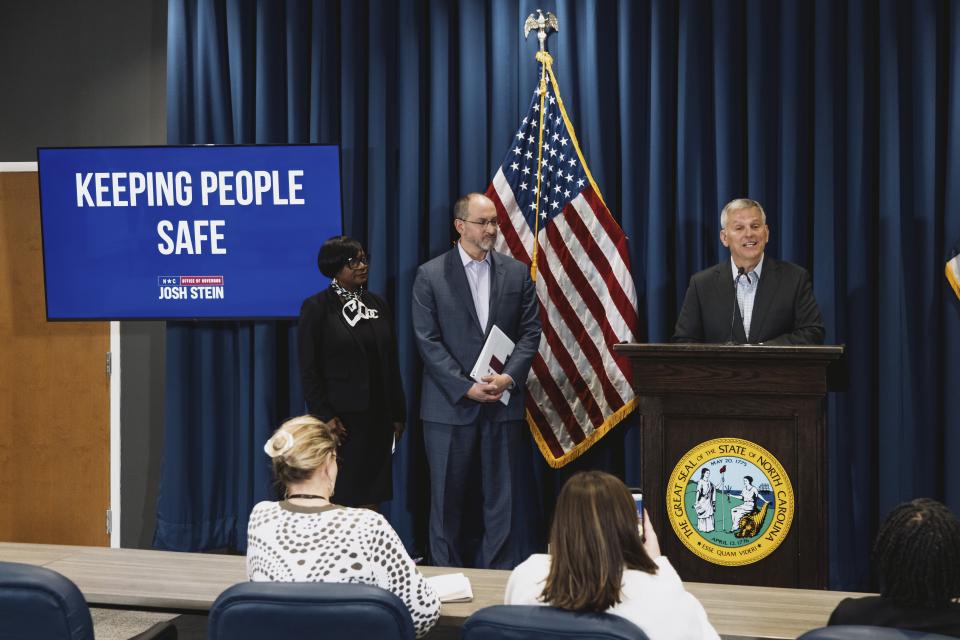
“Domestic violence is a heinous crime that is all too common. Too often, an abuser’s first victim is not their last, and several recent incidents of violence in our state were preceded by the perpetrator abusing a family member or partner,” said Governor Josh Stein. “If you are currently experiencing domestic violence or you know someone who is, resources are available to get you to safety.”
"At the Department of Administration, we are proud to support programs that help people leave abusive relationships through our Division for Women & Youth and the NC Domestic Violence Commission," said Secretary of Administration Gabe Esparza. "Domestic violence does not discriminate; no matter your race, age, socioeconomic class, sexual orientation, religion or gender — abuse can happen to anyone. Each one of us can help stop the cycle of domestic violence by knowing how to spot abusive behaviors and where to direct people who need help."
"We cannot simply tell survivors to leave. We must build the conditions that make safety possible," said Representative Monika Johnson-Hostler. "Survivors should not have to choose between their safety and keeping a roof over their heads or meeting their family's basic needs. We must also ensure local programs have the funding and resources to provide comprehensive services and invest in prevention."
The NC Department of Administration’s Division for Women and Youth provides funding to 76 domestic violence programs in 97 North Carolina counties. These programs offer shelter, counseling, 24-hour crisis lines, transportation, and court and advocacy services. More than 60,000 adults and children received domestic violence services remotely and in person, and more than 100,000 crisis calls and chats were received from individuals seeking domestic violence assistance from those DOA-funded programs during fiscal year 2024-25.
For additional resources, including a directory of state-funded domestic violence agencies, visit the Division for Women and Youth website.
Strengthening 911 Services
Governor Stein announced that the North Carolina 911 Board has awarded more than $13 million in grant funding this year to support critical equipment upgrades and facility enhancements for public safety answering points (PSAPs) across North Carolina. These investments help ensure that the centers answering 911 calls are best equipped to serve their communities effectively and reliably.
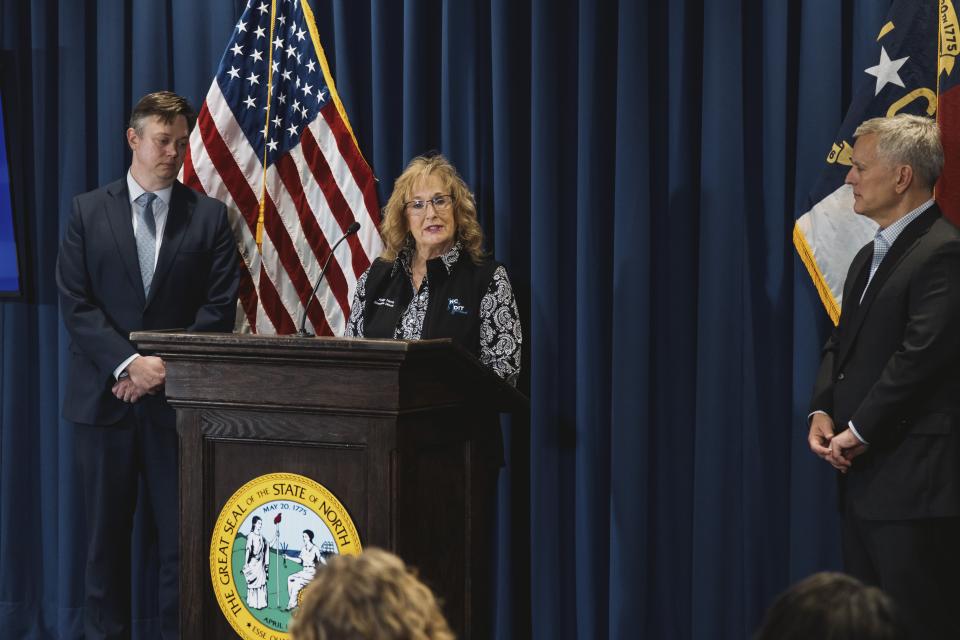
“Every second matters when someone calls 911,” said Governor Josh Stein. “These grants will give 911 operators the resources and technology they need to better connect North Carolinians with the help they need quickly. And 988 is another valuable tool for people experiencing mental health crises.”
“Reliable 911 telecommunications are essential to keeping North Carolinians safe,” said NC Department of Information Technology Secretary, State Chief Information Officer, and NC 911 Board Chair Nate Denny. “Investing in the tools and capabilities our 911 centers need reinforces the trust people place in 911 and ensures every call for help is met reliably and quickly.”
“The N.C. 911 Board remains dedicated to working alongside local PSAPs, ensuring they have the resources and support needed to carry out the critical, lifesaving responsibilities that protect our communities,” said L.V. “Pokey” Harris, Executive Director of the NC 911 Board. “Year after year, the PSAP Grant Program continues to demonstrate its value as a strong, reliable source of funding that enhances the board’s annual 911 PSAP distribution and helps advance our mission.”
Over the past decade, the NC 911 Board's Grant Program has invested more than $104 million to help counties and municipalities strengthen 911 emergency communications across North Carolina. Those investments have included modernized 911 centers and radio system components, computer-aided dispatch technology, and training programs for professionals.
This year’s grants awarded include:
Alexander County E-911 Communications – $640,184.10 for radio console upgrades
Bertie County Communications – $748,093.90 for radio console replacement
Brunswick County Central Communications – $54,107.19 for cybersecurity upgrades and hardening
Charlotte-Mecklenburg Police Communications – $1,927,216.91 for radio console replacement
Granville County Communications – $509,202.30 for radio upgrades
Jones/Lenoir Communications – $944,801.08 for site upgrades
Lumberton Police Communications – $120,949.11 for backup radio upgrades
Montgomery County 911 Communications – $615,489.02 for new primary and backup radio replacements
NC State Highway Patrol – $4,110,916.90 for replacing radio dispatch consoles and logging recorders (while not an N.C. 911 Board-funded PSAP, the Highway Patrol is eligible to receive board-funded grants pursuant to G.S. 143B-1407)
Robeson E-911 Communications – $1,090,906.72 for radio replacements
Rutherford County Communications – $53,974.06 for radio console replacement
Stanly County 911 – $518,913.56 for radio console replacement
Union County Communications – $565,176.68 for radio console replacement
Wilson County Emergency Communications – $1,255,628.73 for radio console replacement
The NC 911 Board, a unit of the NC Department of Information Technology, oversees the statewide effort to create and maintain an enhanced, fully integrated 911 system for all voice communication technologies.
The 911 Board manages the uniform 911 service charge collected by telephone and voice communication providers, directing this revenue into the 911 Fund. These funds support 124 public safety answering points, which are operated by counties and other local government entities throughout North Carolina and employ nearly 3,000 telecommunicators.
Anyone experiencing mental health distress can also call or text 988 or chat at 988Lifeline.org and speak with a trained mental health specialist. People who speak Spanish can now connect directly to Spanish-speaking crisis counselors by calling 988 and pressing option 2, texting “AYUDA” to 988, or chatting online at 988lineadevida.org or 988Lifeline.org. For additional support, call the NCDHHS Peer Warmline at 1-855-PEERS NC (855-733-7762) to speak with a peer support specialist, someone who understands.